

Victor Hugo’s Animal Friends
Victor Hugo’s Animal Friends
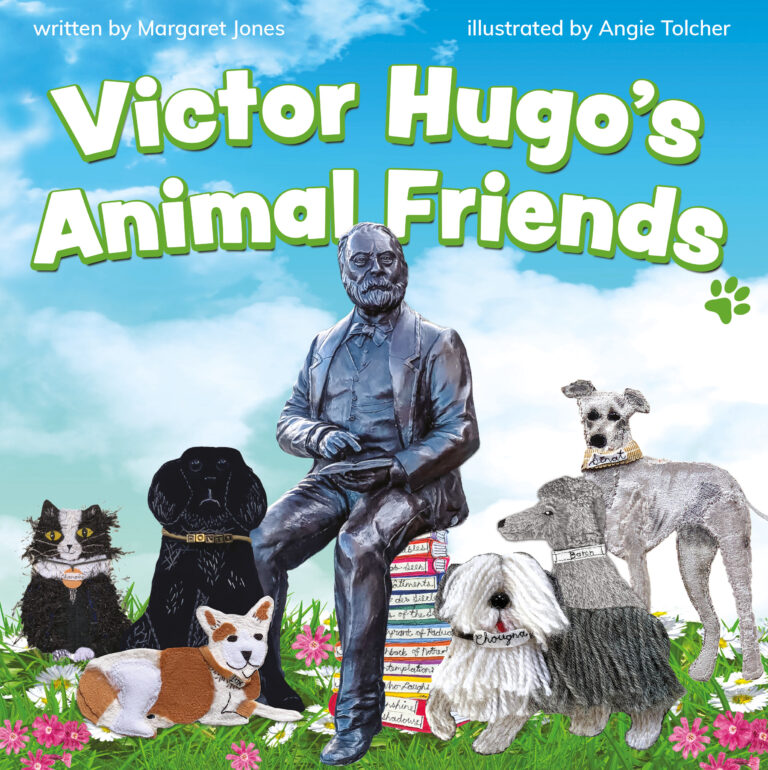
is a book by Margaret Jones and illustrated by Angie Tolcher, which introduces young readers to the celebrated French writer.
This delightful series of illustrated rhymes is the first of its kind in English. It aims to engage and acquaint readers not only with Victor Hugo’s literary works but also with his strong advocacy for social justice which he championed through education.
The book highlights his deep affection for animals, his love for his grandchildren and his years of exile in the Channel Islands.
It aims to foster an early sense of environmental stewardship in its readers reflecting on Hugo’s profound appreciation for the natural world and his commitment to the protection of the flora and fauna of the Islands.
Price: £12
Available from www.blueormer.gg
Educational Resources for Victor Hugo’s Animal Friends
Download a free copy of the resource pack here:
Copyright © Margaret Jones 2026.
1. Victor Hugo in Exile
Victor Hugo (1802–1885) was a French poet, dramatist, novelist, statesman and a prominent campaigner for peace and human rights. He became one of the most important French Romantic writers of all time. He is best known as a poet and for his epic novels, Notre-Dame de Paris and Les Misérables.
Adèle Hugo née Foucher (1803-1868) was Victor’s childhood sweetheart who became his wife. Adèle’s wish to help mothers and the starving children of Guernsey was the inspiration for Hugo’s project to feed the poor children.
Exile is where it is necessary to leave one’s country and live in a foreign country. When Napoléon III took absolute control of France in 1851, he undermined their democratic system of government. For this, Victor labelled him ‘a traitor to his country.’ This remark made him unwelcome in his homeland and he went into exile. He first fled to Brussels, then to Jersey. Finally, he took residence in Guernsey where he lived in exile from 1855-1870. He returned to live mainly in France after the fall of Napoléon III.
Poor children. Victor saw that many of the poor children in Guernsey were starving and so found it difficult to learn to read and write. Adèle gave practical help to women and children and Victor made speeches to support his project to feed them. He said that all children should be able to eat healthy food and receive a good education.
Hauteville House was where Victor lived for nearly 15 years (1855-1870) during his exile from France. He was able to buy this property from the proceeds of Les Contemplations.
The ‘Look-out’ at the top of the house became Victor’s writing room with views across to the islands of Herm and Sark. He liked to write standing up. On a fine day, he could see the coast of France.
The Toilers of the Sea, Les Travailleurs de la mer, is a novel which explores the themes of honour, love, and betrayal. At the very beginning of the book, Victor dedicated this novel to the island of Guernsey in gratitude for the island offering him sanctuary:
“I dedicate this book to the rock of hospitality and liberty, to that portion of old Norman land inhabited by the noble little island nation of the sea, to the island of Guernsey, severe yet gentle.”
2. Victor Hugo and Nature
The Oak of the United States of Europe. On Bastille Day, 1870, days before the start of the Franco-Prussian war, Victor planted an acorn in his garden at Hauteville House in the presence of his son, Charles, and his grandchildren, Georges and Jeanne. He hoped it would grow into an oak and would see Europe united and at peace.
The Serpentine Fountain La Fontaine aux Serpents. According to Victor’s son, Charles, this fountain was in the gardens of the Hôtel de Rohan Guéménée, Place Royale, where he had lived in Paris. It was brought to Guernsey and installed in the garden at Hauteville House in 1856.
Ormers are edible sea-snails or abalones. They have ear-shaped shells lined with mother-of-pearl. Until the late 19th century, Norman French was the dominant language in Guernsey and until then, an ormer was known as an oreille de mer, sea-ear in English.
Moulin Huet was where Victor’s family and friends liked to go to have picnics. This place inspired his creativity as a writer and he liked to take his walks there with his dogs. There are photographs of him with his family and friends outside a cottage that Renoir later depicted in his paintings.
Campions are star-shaped flowers that vary in colour; red, white, or pink. They have been described as ‘little warriors coming to change the world.’ In flower language, they convey a message of quiet strength and a love as enduring as the coastal paths to which they cling. In The Toilers of the Sea, Victor described the flowers he saw in the natural environment of Guernsey:
‘The fruit-trees filled the orchards with their heaps of white and pink blossom. In the fields were primroses, cowslips, milfoil, daffodils, daisies, speedwell, jacinths, and violets. Blue borage and yellow irises swarmed with those beautiful little pink stars which flower always in groups, and hence called compagnons.’
My thanks to Timothy Adès for his English translation of these poems that Victor Hugo wrote about his love of spiders and stinging nettles, butterflies, and flowers.
The poem, I Love the Spider and I love the Nettle J’aime l’araignée et j’aime l’ortie in Victor Hugo’s Les Contemplations, published in 1856, challenges readers to overcome prejudice. It highlights the hidden utility and beauty of despised things, urging compassion for the ‘ugly’ and ‘hateful’ aspects of nature. The poem champions the ignored and maligned ‘weed’ which can often have a value when properly understood or ‘cultivated.’ The nettle represents the outcasts from society or neglected individuals who, with care, could be useful. The poem is part of a broader theme in Hugo’s work that advocates for empathy, notably referenced in Les Misérables.
‘My friends, there is no such thing as a weed and no such thing as a bad man. There are only bad cultivators.’
This poem reflects Hugo’s philosophical view that nothing in nature is inherently evil, rather, it is often human perspective or neglect that deems it so.
I Love the Spider by Victor Hugo Translated by Timothy Adès
I love the spider and the nettle
Since they are hated;
Their sorry needs are penalised
And never sated;
Since they are paltry and accursed,
Dark lurking things,
Since they are wretched prisoners
Of their snarings:
Since they are caught in their own toils,
Coiling too clever,
And since the nettle is a snake,
Ragtag the weaver,
Because they have the shade of chasms,
From which we flee,
Because they both are dark night’s victims,
They gladden me.
Passer-by: pity the dim weed,
The hapless creature!
Carp at the sting, the ugly sight,
The misadventure!
All things know sadness, all desire
To be embraced.
Untamed and vile they are: but – spare,
Leave them uncrushed!
Throw them a less disdainful glance
From far above:
The loathsome beast, the evil plant,
Will murmur: Love!
The Butterfly and the Flower Le papillon et la fleur is a poem from Victor Hugo’s 1835 collection Songs of Twilight Les Chants du crépuscule. It depicts a, melancholic, unequal love between a rooted flower and a flying butterfly, symbolizing the impossible romance between a stationary lover and a restless, fleeting beloved. Written in 1834, the poem reflects the relationship between Hugo and his mistress, Juliette Drouet, with themes of abandonment, longing, and the pain of separation. The ‘poor flower’ la pauvre fleur represents the waiting, devoted party, while the ‘heavenly butterfly’ papillon céleste represents the fleeting, free spirit. The flower complains of being chained to the earth, while the butterfly constantly flies away. The poem contrasts the stillness of nature with the desire for connection, featuring the recurring image of the flower left alone, watching her shadow at her feet. It is famously set to music by Gabriel Fauré as the first of his two Mélodies, Op. 1. The poem was a significant part of the shared imaginary world of Victor Hugo and Juliette Drouet, often referenced in their personal correspondence.
The Butterfly and the Flower by Victor Hugo. Translated by Timothy Adès
Poor flower to glorious butterfly would say:
Hold hard! Stand by!
Observe our destinies, ill-matched! I stay,
You leave; you fly.
Yet we are lovers, and we sojourn far
From humankind.
We are alike: it’s mooted that we are
Flower-forms, twinned.
But, ah! You ride the air, I’m chained to earth,
So cruelly!
I’d make your soaring fragrant with my breath,
In heaven high.
But you depart to where no pallor shades
The petals sweet,
While I, left lonely, watch my shadow fade
Around my feet
You leave, and you return, and you are gone,
Mercurial, bright,
Discovering anew at every dawn
My tearful plight!
Let faithful days inform our flutterings,
My king of love:
Take root like me, or fit me out with wings,
Like yours above!
3. Papapa’s Animal Friends
Grise was one of the female cats owned by Auguste Vacquerie, a friend of the Hugo family. In his Profiles and Grimaces 1856, he devoted several pages to describing Victor’s animal friends including Ponto, Chougna, Lux, Mouche, and Marquis, alias Sénat. Grise was known as the ‘prison cat’ because she was born in the Conciergerie in Paris. She was a consolation for Auguste Vacquerie when he was imprisoned there for collaborating with Victor and his two sons on articles in the newspaper L’Evènement. Grise accompanied Madame Hugo and her daughter, Adèle, to take exile in Jersey.
Mouche was a big black and white cat and daughter of Grise who belonged to Auguste Vacquerie who commented that Mouche seemed to know she was born in exile to a mother born in prison. He described her as: ‘silent and reserved, shady and sinister, truly the cat of the prison and of exile.’ Victor described Mouche as ‘solitary and beautiful, black and glossy, a dark light.’ He thought she looked:
‘as if she was dressed for the masked ball, wearing her black velvet mask on her forehead that reveals her white chin, her fine teeth, and the tip of her pink nose, and wearing her black velvet coat trimmed in front with wide ermine bands on her shoulders.’
Sénat was a magnificent white Italian greyhound which Victor’s wife, Adèle, brought to Guernsey from Brussels. Victor did not like the noble title of Marquis that his son, Charles, gave to this dog. Despite family objections, he insisted Marquis should be renamed Sénat, the name of the upper house of the French Parliament to which he was elected in 1876. Sénat liked to sit on a red chair in the Red Salon at Hauteville House. Victor had a rhyme engraved on a medallion and attached it to Sénat’s collar. It read:
‘Je voudrais que chez moi quelqu’un me ramenât. Mon état, chien; mon maître, Hugo; mon nom, Sénat.’
‘I would like someone to bring me back home. My status, dog; my master, Hugo; my name, Sénat.’
When Sénat died, he was taxidermised and eventually presented to the Guille-Allès Museum by Victor’s sister-in-law, Julie Chenay. He has since disappeared, but his collar is kept safely in Paris.
Ponto was Victor’s beautiful and good-tempered spaniel. He wrote about him in a poem entitled Le Chien Ponto which he included in his collection Les Contemplations. In this poem, Victor described his dog’s faithfulness and his simple and virtuous nature. Graham Robb described Ponto as ‘a thinker and silent conversation partner who followed Victor on his walks and inspired his poetic meditations.’ This extract from the poem shows how Victor used nature and animals to express ideas about life, truth, and spirituality. Here he contrasts his dog’s virtuous nature with the false virtues of men. In this extract written in March 1855 at Marine Terrace, Jersey, he wrote:
‘And although I say “All is deception, imposture and lies, iniquity, evil dressed in splendour,”
I say to my black dog: Come, Ponto, come to us!
And I go into the woods, dressed like a peasant;
I go into the great woods, reading in the old books.
In winter, when the foliage is a case of frosts,
Or in summer, when everything laughs, even the weeping dawn,
When all the grass is but a triumph of flowers,
My dog Ponto follows me
The dog is virtue that, unable to become a man,
Has become a beast
And Ponto looks at me with his honest eye.
The Contemplations (1856) Book 5 XI ‘En Marche’ (Forward)
Gavroche was the name Victor called the kitten that he gave to his grand-daughter, Jeanne. This kitten was probably named after the fictional young boy fighter who lived on the streets of Paris and took shelter with his brothers in an elephant statue. In Les Misérables, the character Gavroche is depicted as having played a short but important role in the June rebellion in 1832. Victor is thought to have named two or more of his cats Gavroche.
In Les Misérables 1862, Victor described the thoughts of another young student fighter, waiting at dawn on the barricades and musing about the reason for the creation of the cat:
‘After all, what is a cat?” he asked. It is a correction. Having created the mouse, God said to himself, “That was silly of me!” and so he created the cat. The cat is the erratum of the mouse. Mouse and cat together represent the revised proofs of creation.’
Jean Valjean. Tome V. Les Misérables 1862
Lux, Latin for light, was a handsome white greyhound with two darker spots on his back and head that apparently made him look like a small saddled and bridled horse. He may have been named after the last poem in Les Châtiments, The Punishments (1853), the hymn that Victor wrote to ‘universal peace’ when he was in exile. Lux was described as: ‘restless, delicate and fearful’ but Charles Hugo, the father of Georges and Jeanne, loved this dog’s gentle and affectionate nature. He took a photograph of him playing with Sénat in the garden at Hauteville House.
Chanoine, Chancellor was the name Victor gave to his famous long-haired Abyssinian cat. He was fond of him and described him as a ‘good companion and a wise cat.’ There are anecdotes about Chanoine’s intelligence; his ability to open doors and his habit of sitting on Victor’s desk while he was writing. A drawing of Chanoine, entitled The Cat of Victor Hugo, appeared on the cover of The Cats – History, Morals, Observations and Anecdotes 1869 compiled by Champfleury whose real name was Jules Fleury-Husson, a French art critic and novelist. He said that, in his youth, he was received by Victor Hugo at the Place Royale in Paris in a salon decorated with tapestries and gothic monuments. In the middle of the room there was a large red cushioned seat on which sat a cat that seemed to be awaiting the homage of its visitors. He wrote this description of Chanoine:
‘A vast collar of white fur stood out like a chancellor’s cloak on his black robe. The moustache was that of a Hungarian Magyar, and when solemnly the animal approached me, looking at me with its fiery eyes, I understood that the cat had shaped itself after the poet and reflected the great thoughts that filled the home.’
Beneath Chanoine’s picture in the book, Victor wrote a quote from Joseph Méry (1797-1866), a French writer who said he had once stroked Chanoine ‘with cautious joy’, and had observed that:
‘God invented the cat so that man would have the pleasure of stroking a tiger in his own home.’
Baron was Victor’s hunter poodle which, according to Rupert Willoughby’s ‘Account of the incredible journey of Baron, Victor Hugo’s dog’ in the Telegraph 2010, was ‘a sturdy, retrieving type’ of whom Victor was very fond. However, it seems that Baron demanded constant attention. His granddaughter, Jeanne, remembered it in Guernsey. She said that, in 1877, Victor gave this dog to an old Marquis, possibly the Marquis Nicolas de Faletans, who was returning to Russia. The Marquis was thought to have lost the dog and Baron was presumed dead. However, on Christmas Day, the poodle arrived, hungry, tired, and barking at Victor’s front door; it had somehow managed to make the trip home. When Victor’s granddaughter, Jeanne, became Madame Daudet, she listened to this story and said she had grown up with this dog in her grandfather’s house in Guernsey. She remembered how deeply moved her Papapa had been by Baron’s devotion to him.
‘One evening, early in 1877, the Marquis de Faletans was attending Hugo’s salon in his 4th floor apartment in Paris, at 21 rue de Clichy. Victor noticed him making a fuss of the dog. ‘Does Baron please you?’ he said. ‘He’s yours!’ Eight days later they departed for Russia, where the Marquis was to reside for a time with his wife at Great Bokino, her country estate, some 200 miles south-east of Moscow. Regular news was sent to the Hugos, but in mid-December, after a period of ominous silence, the Marquis reluctantly reported that the dog was missing, feared seized by a wolf or a bear. Hugo, who had resigned himself to the loss, was roused from his bed on Christmas morning by his cook, who lived on the ground floor. An exhausted, emaciated Baron had appeared on the doorstep and announced himself with frantic barks. Victor was touched to the core, and amazed that Baron had travelled nearly 2,000 miles in less than a month. He resolved that they should never again be parted, and, indeed, Baron accompanied the family to Guernsey and later to a new apartment in Paris, where he died, a few months before his master, in 1884.
By kind permission of Rupert Willoughby
Chougna, (fr. slang chougner– to whine) was a long-haired sheepdog that had once belonged to François-Victor, one of Victor’s sons. She was an affectionate female dog always ready to jump on people’s necks with her big paws. Chougna became Victor’s guard dog. In a letter to Paul de Saint-Victor, French essayist and literary critic, Victor wrote: ‘I take great care of Chougna and Mouche. Tell Auguste this, passing on my handshake.’ V.
Correspondence, National Library, Paris.
In his poem Ma chienne, la Chougna, My bitch, the Chougna, Victor admitted that this dog was a source of frustration but showed the great affection he had for this dog:
‘I took her by the ear and said to her, ‘Why, Chougna, do you behave badly, before the everyone? Why, when we go out, do I have to scold you? Why do you run barking, howling, through the bushes after the young dogs and the little boys? Why can’t you see a rooster without chasing it? You seem to me like a drunken dog! It makes us look bad and people are irritated. I know you have many good qualities, faithful, intelligent, affable; but really, when you go out, you are not reasonable!’
Victor Hugo, Oeuvres Complètes, Paris: Hetzel-Quantin, 1880 -1889, T. X1V.
Victor’s friend, Juliette Drouet, disliked this whining guard-dog who was hairy and unkempt and always barking. She complained to Victor that Chougna was mangy and badly-behaved. In one of her letters to Victor in November 1862, she described Chougna as ‘a poor mangy bitch’ and urged him to get rid of her, but he refused. Victor was devoted to Chougna and continued to care for her.
CREDIT AND COPYRIGHT: This material is shared under the Creative Commons Attribution-NonCommercial-ShareAlike 4.0 International License; you are free to use, share and adapt this material for non-commercial purposes on condition that you give appropriate credit to the author, and provide a link back to the source of this material.